
What a personal trainer actually does
A personal trainer is a qualified coach who writes and delivers a structured training programme, teaches you how to move well under load, and holds you to it. That is the whole job. Everything else, motivational content, meal plans, transformation reels, is decoration on top of a very old and very simple contract: a professional watches you train, corrects what needs correcting, and progresses you week by week toward a specific goal.
The reason personal training works, when it works, is that it removes three things that stop most people from making progress on their own. It removes the uncertainty about what to do (the coach writes the programme). It removes the technique blind spot (the coach watches every set and fixes what your phone screen and mirror cannot show you). And it removes the accountability problem (someone is expecting you at 6:30am on Tuesday). Take any one of those three away and progress slows dramatically. Take all three away and most people plateau, hurt themselves, or quit.
That is why the coached model outperforms self-led training so consistently. It is not a personality problem. It is a structural one.
Personal training in Leamington Spa and Warwick
The Leamington Spa and Warwick area has a strong personal training market. You will find independent trainers renting floor space at commercial gyms, coaches running one-to-one sessions out of small private studios, franchise-model PT chains, and a smaller number of properly coaching-led gyms where every member is coached in person every session. Rates vary widely with experience, specialism and setting, and the difference between the entry end and an established coach with a full private studio is substantial.
The area also has a distinct kind of client. Most people we speak to at Physical Formula are professionals between 35 and 55, often with school-age children, often working out of Warwick, JLR Whitley, Coventry or one of the surrounding villages. They are not looking to compete in bodybuilding. They want structure, safe technique, honest coaching and a session that fits their diary. A traditional one-to-one personal trainer can deliver that. So can coaching-led small group personal training, and for a very different price.
Why the gym membership didn’t work
If you have a gym membership quietly gathering dust, you are in the biggest club in Britain. The average member visits about four times a month and lets the membership lapse within a year. It is easy to read that as a willpower problem. It almost never is.
A membership hands you a room full of equipment and leaves the rest to you: the programme, the technique, the reason to turn up on a wet Tuesday in November. Some people genuinely thrive with that freedom. Most people, with real jobs and full lives, need more structure than an open door. That gap between access and support is not a personal failing. It is simply the reason personal trainers exist.
A gym membership gives you access to equipment. It doesn’t give you a programme, coaching, accountability, or anyone to notice whether you turned up.
What a gym membership actually gives you (and what it doesn’t)
None of this is a criticism of gyms. It is just worth being precise about what a membership includes, because the marketing often gently implies more.
What you do get
- Access to equipment. Machines, free weights, cardio, often a pool or studio for classes.
- Wide opening hours. Most chains run 06:00 to 22:00 or longer.
- Flexibility. Train when you want, where you want, no booking required.
- Group fitness classes. Body Pump, spin, yoga, HIIT, usually included.
- An induction. One free session at sign-up showing you how to use the equipment.
What you don’t get
- A programme. Nothing tells you what today should look like, or how this week builds on the last one. That part is left entirely to you.
- Coaching. The floor isn’t coached. The induction shows you the machines, not how to progress on them.
- Accountability. If life gets busy and you quietly stop coming, nobody notices. That silence is where most memberships go to sleep.
- Progression. Equipment doesn’t programme itself. Most people progress quickly for six weeks and then settle onto a plateau nobody helps them off.
- Being known. Big gyms are anonymous by design. You can train there for years and never once be asked about your week.
If some of that list is exactly what you need to make training stick, then the membership was never the wrong product. It was just the wrong product for you, and knowing that is half the decision made.
Where small group PT fundamentally outperforms
Coaching-led small group personal training isn’t a tier-up gym membership. It’s a different product. Here’s where it changes the equation.
Programming
Every session is part of a programmed block. You aren’t designing your training; a coach has. The programme moves over six to twelve weeks, you progress strength lifts, build conditioning, then test outputs. The work compounds. You don’t plateau at six weeks because the programme accounts for plateau and pushes through it.
Coaching on every lift
Every session, every member, observed. A coach watches your set-up on the bar, your bracing under load, your tempo, your depth, your knee tracking. They cue you in real time. Two months in, you’re lifting better than members who’ve been in commercial gyms for two years, because nobody ever told them their squat was shallow.
Built-in accountability
Sessions are booked. You’re expected. If you miss two in a row, your coach asks why. That sounds small until you realise it’s the difference between training fifty times a year and training a hundred and fifty times a year. The compounding effect over a decade is enormous.
The room itself
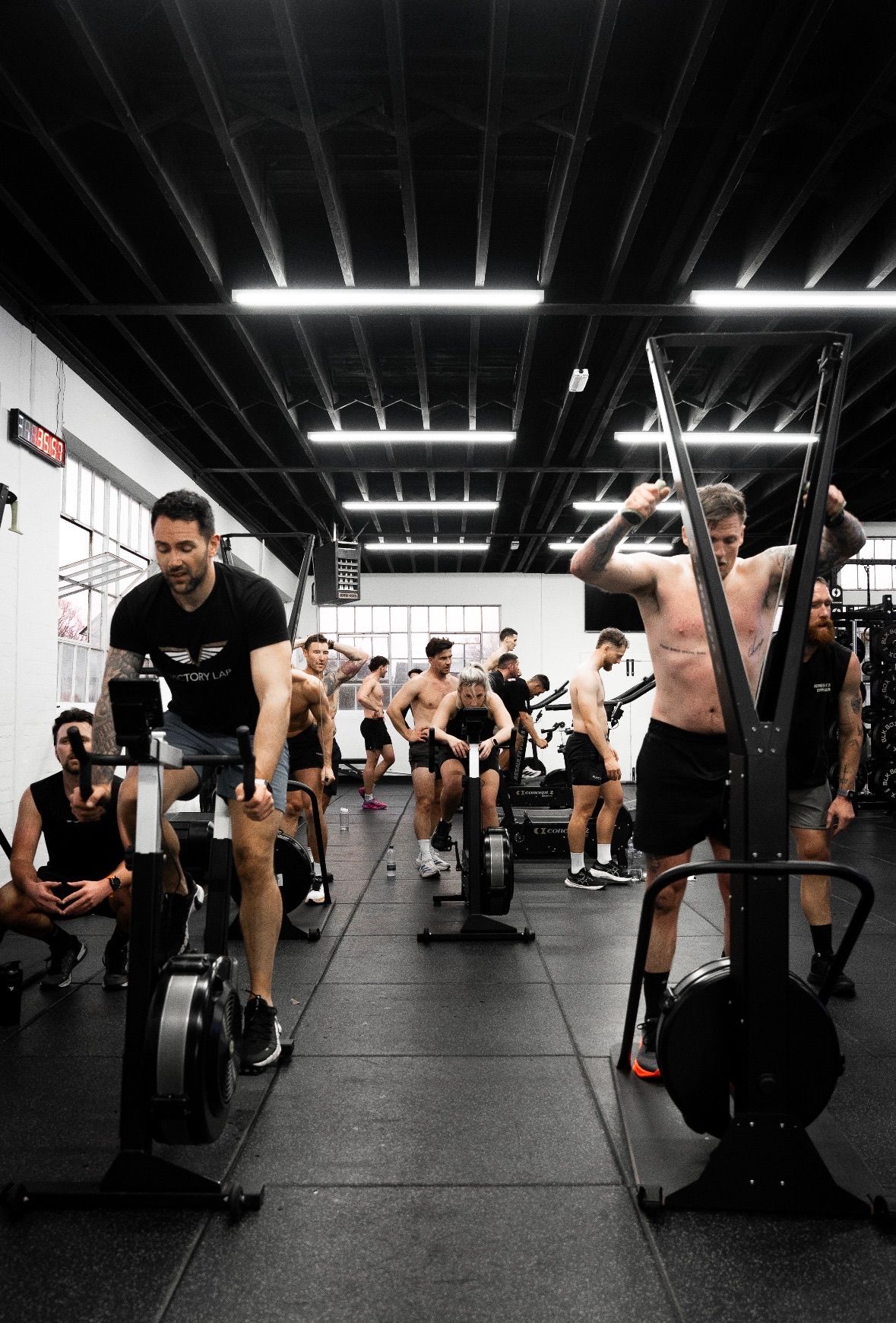
Training in a room with four to seven other people who showed up to do the same hard thing is a completely different experience from training next to someone on their phone between sets. You push harder than you’d push alone. You stay later. You progress faster. Group energy is real, and it’s actively designed into how we coach.
Knowing your coach (and your coach knowing you)
After a few weeks, your coach knows what your set-up looks like when you’re moving well and what it looks like when something’s off. That continuity is impossible in a 5,000-member gym where you might see the same staff member twice a year. Coaching depends on someone knowing you, and a small group studio is built around that knowing.
Small group PT vs one-to-one PT
One-to-one personal training works. The attention is total, the programme is bespoke, the feedback is immediate. But for most people, coaching-led small group personal training is not the compromise option. It is the better product. Here is why, and if you want the side-by-side version, we have laid out the full comparison of one-to-one PT and coached small group training on its own page.
The coaching is the same. The economics are not.
In a properly run small group, the coach writes the programme, watches every working set and cues you in real time, exactly as they would one-to-one. The difference is that four to seven members share the coach’s hour, so each coached session costs a fraction of a private one. Same coaching model, sustainable price. That matters more than it sounds, because the biggest predictor of results is not how good your first month of training is. It is whether you are still training in year two.
One-to-one PT tends to end. Small group PT tends to last.
Most one-to-one PT relationships finish when life shifts, a budget review, a house move, a new school run. And when the sessions stop, the progress usually stops with them, because the client was renting the trainer’s structure rather than building their own. Small group members stay for years, our longest-standing members have trained with us since the doors opened, because the format is affordable enough to be a permanent part of the week rather than a short-term push. Consistency over years beats intensity over weeks, every time.
The room does work a trainer cannot.
Training alone with a trainer is quiet. Training in a room of four to seven people who all turned up to do the same hard thing changes your output. You push harder than you would alone, you match the effort around you, and on the days your own motivation is thin, the room carries you. That energy is not a nice-to-have. It is a performance variable, and it simply does not exist in a one-to-one session.
Accountability multiplies.
With a personal trainer, one person notices if you go missing. In a small group, your coach notices and so do the people you train alongside. Miss two sessions and someone asks where you were. That web of low-key expectation is why small group members attend far more sessions per year than gym members, and more consistently than most one-to-one clients too.
You learn faster in a room being coached.
In a small group you do not only receive your own cues. You hear the coach fix the person next to you, watch the correction land, and absorb it before it is ever your problem. Members pick up movement literacy noticeably faster this way than in one-to-one settings, where every lesson has to be learned first-hand.
Fixed sessions build a routine. Flexible ones erode it.
One-to-one PT is usually scheduled week by week around two diaries, which sounds convenient and in practice invites drift. Small group sessions run at fixed times. Tuesday 6:30am is Tuesday 6:30am, and within a month it is simply part of the shape of your week. Routine is what survives busy periods. Flexibility is what dissolves in them.
No dependency.
A subtle failure mode of long-term one-to-one PT is that the client becomes dependent on the trainer standing next to them. Small group training builds capability alongside coaching, you learn to warm up, load the bar, read the programme and manage a session, because the format expects it. You are coached, not chaperoned.
One-to-one still wins in specific cases, which we cover below. But if the goal is years of coached, progressing, sustainable training, the small group format is not the budget version of personal training. It is the version that keeps working.
The honest value comparison
We deliberately do not publish a price table in a blog post, numbers date quickly and every option prices differently by frequency. But the structure of the comparison is stable, and it is worth being honest about.
Commercial gym membership
The cheapest monthly figure by far, and the most expensive per result. You are paying for access, not outcomes. National attendance data suggests the average member uses a fraction of what they pay for, and programming, coaching and accountability are not included at any price.
One-to-one personal training
The highest level of attention and the highest investment, typically several times the monthly cost of any other option at a meaningful frequency. Total coaching, bespoke programming, real results, and a running cost that most people eventually step away from, taking the structure with them.
Coaching-led small group personal training
Sits deliberately between the two. Every session coached, fully programmed, accountability built in, for a fraction of the one-to-one session cost. Because the price is sustainable, members attend more sessions per year than either gym members or most one-to-one clients, and it is attended sessions, not memberships owned, that change a body.
If the goal is to genuinely change how you feel and how you train, rather than simply to own a membership, the value sits firmly with coached training. Our pricing lives on the Small Group PT page and gets talked through properly on a discovery call, matched to how often you actually want to train.
When a gym membership IS the right choice
None of this is to say nobody should have a gym membership. They’re excellent products for the right person. Specifically:
- If you already know how to programme. You write your own training, you progress your own lifts, you’ve done it consistently for years.
- If you train completely independently and prefer it. Some people genuinely want headphones in and to be left alone. That’s a valid way to train.
- If you primarily use the gym for cardio or one specific machine. Pool, treadmill, sauna, if that’s 90% of your use, a membership is perfect.
- If your budget genuinely doesn’t allow coached training. Then a gym membership and a smart self-led programme is far better than nothing, just be honest that the responsibility for results sits entirely with you.
The general public-health framework is well established, the NHS Physical Activity Guidelines remain the canonical minimum-effective-dose baseline. A gym membership absolutely allows you to hit those targets. Whether it allows you to progress beyond them is a different question.
How to switch from gym to coached training
If the comparison has landed and you’re thinking about switching from a commercial gym to coached training, a few practical notes from members who’ve made the same move.
First, the switch is rarely instant. Most people we coach were a member of a chain gym for two to five years before they came to us. The trigger is usually progress stalling, motivation evaporating, or a specific event (a milestone birthday, a HYROX race, an injury that needs proper coaching).
Second, you don’t need to be fit to start. Most new members start somewhere between completely new to training and returning after a gap of a few years. Our onboarding session is designed to put you in the right group at the right level.
Third, the cost shift is usually less than people expect. If you’re currently paying for a gym membership you’re not really using, plus the occasional one-to-one PT block, the move to consistent small group PT often costs about the same per month and delivers dramatically more.
Fourth, the time commitment isn’t bigger. Two coached sessions a week, properly programmed, delivers more than four uncoached sessions a week. You’re trading hours of fumbling for sessions of focused work.
How to start with us
You do not need to have it all figured out before you get in touch. Most of the people we coach arrived with nothing more than a feeling that something needed to change, and that is more than enough to start with.
The simplest first step is a short enquiry. Tell us where you’re currently training, if anywhere, and what you’re hoping to change. It takes two minutes, a coach reads every single one, and you’ll hear back within 24 hours, usually sooner. From there it’s a proper conversation, not a pitch.
If you’d rather read a little more first, the getting started page walks through the pathway from first enquiry to first session, and our overview of coaching-led small group personal training covers how we coach, who the coaches are, and who Physical Formula is and isn’t for.