Why strength training matters for women specifically
For years, women’s fitness in the UK has leaned towards cardio: class-based, calorie-burn-led, “tone don’t bulk.” The research tells a different story. A meta-analysis of studies that gave men and women the same programme found that, relative to their starting point, women gained muscle and lower-body strength at a similar rate to men, and upper-body strength faster (Roberts et al., 2020).
Here’s what strength training reliably does that cardio doesn’t.
Body composition. Strength training changes body composition: it builds lean tissue and reduces body fat (Wewege et al., 2022). In an eight-month trial, cardio burned off more fat mass, but only the programmes that included resistance training increased lean mass (Willis et al., 2012).
Bone density. Women lose bone density faster than men once menopause begins (Clarke and Khosla, 2010). Exercise can help slow that loss, and of the types studied, progressive resistance training for the legs appears the most effective for bone density at the hip (Howe et al., 2011). We cover the whole picture, including programming through perimenopause, in our guide to strength training through menopause.
Metabolic health. Muscle is metabolically active tissue. The more of it you carry relative to your size, the better your insulin sensitivity and blood-sugar regulation tend to be (Srikanthan and Karlamangla, 2011).
Mood, sleep and confidence. Strength training has good evidence as a mental-health intervention: meta-analyses of randomised trials show it reduces symptoms of depression (Gordon et al., 2018) and anxiety (Gordon et al., 2017), and a systematic review found it improves sleep quality (Kovacevic et al., 2018). The act of lifting something heavy and progressing what you can lift changes how women feel in their bodies in a way no class ever does.
Functional capacity for life. Carrying shopping, lifting children, gardening, standing up easily as you age, not being afraid of falling at sixty. This is what muscle and strength buy you, and the longer you train, the more compound the benefit.
The NHS recommends muscle-strengthening activity on at least two days a week. That is the minimum-effective dose. Coached, structured strength training at Physical Formula sits well above that, not because more is always better, but because the right kind of training compounds dramatically over time.
Only around one in four women in England meets the muscle-strengthening guideline (Nuzzo, 2020). The answer is not more cardio: it’s coached, progressive strength training.
The “bulky” myth, properly addressed
It’s the most common worry we hear from women coming to coached strength training for the first time: “I don’t want to get bulky.”
You won’t. Men have more than fifteen times the circulating testosterone of women, and that difference is largely why men carry so much more muscle (Handelsman et al., 2018).
What does happen, reliably, with progressive strength training:
- Lean muscle increases, slowly.
- Body fat decreases, slowly.
- The shape of your arms, shoulders, glutes and legs changes: more defined, more held, less soft.
- Your clothes fit differently, often within twelve to sixteen weeks.
- The scale moves less than expected, because you’re adding lean tissue as you lose fat, and lean tissue is denser than fat, so it takes up less space (MRC Epidemiology Unit).
This is the visual outcome women almost always want when they describe “toned.” The reason they don’t get there with class-based cardio is that “toned” is, at the underlying level, a body composition shift, and building the lean tissue behind it takes resistance training (Willis et al., 2012).
The five movement patterns we coach
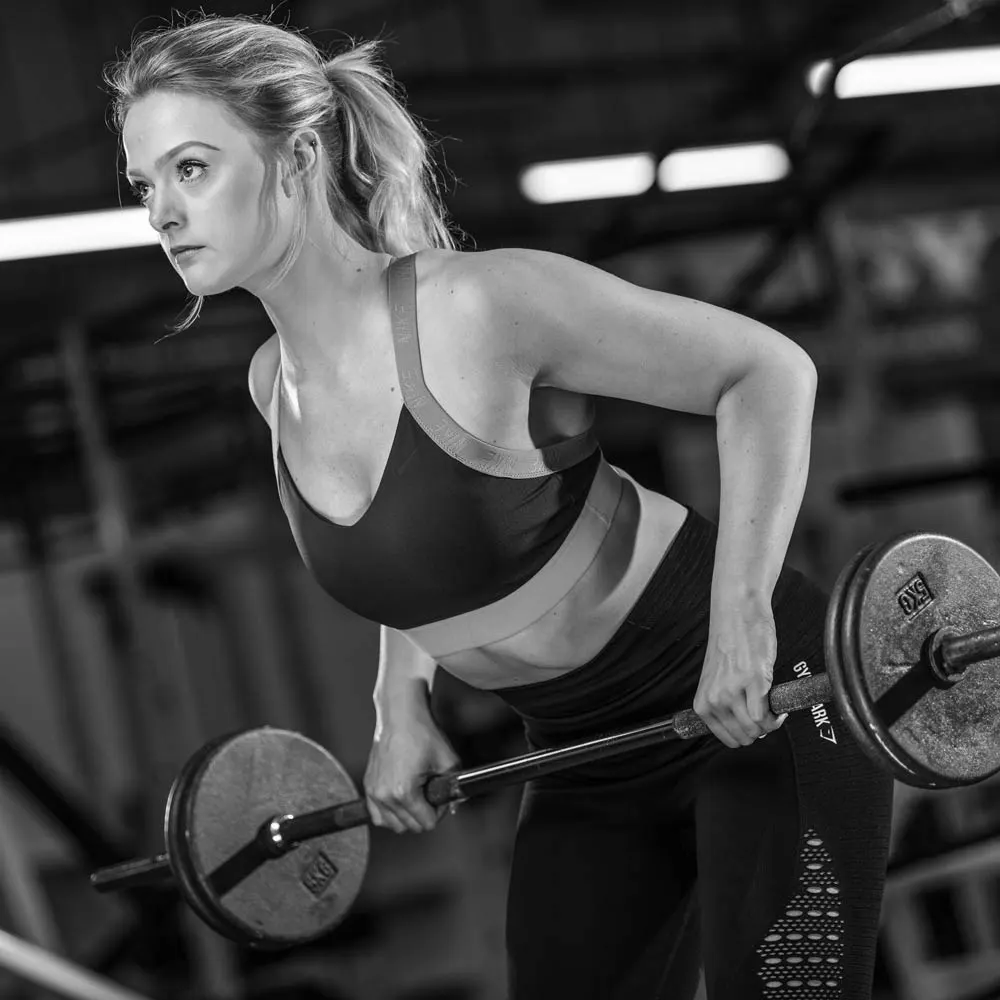
Proper coached strength training isn’t a list of exercises. It’s a small number of foundational movement patterns, coached carefully, then loaded progressively.
Squat
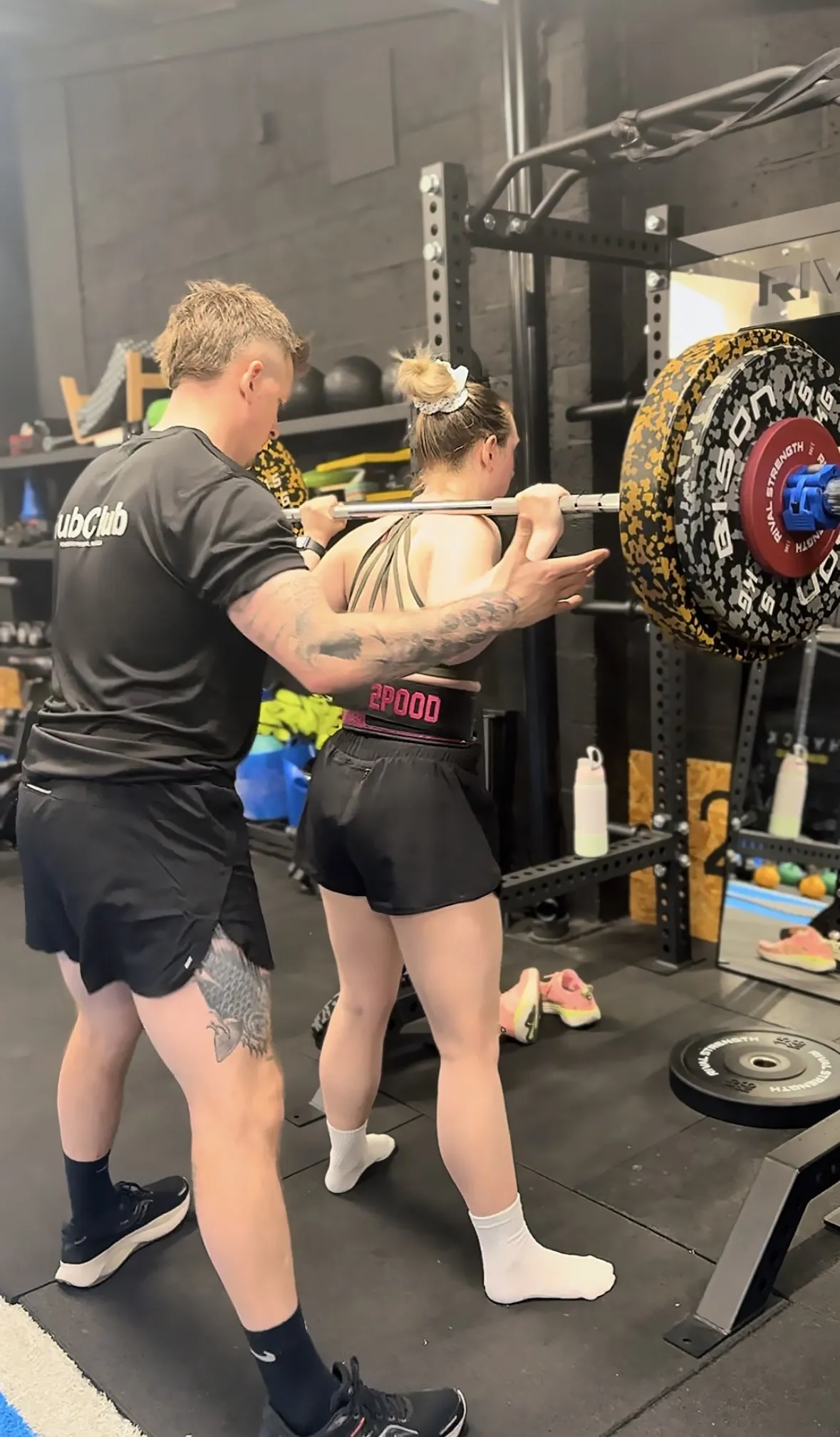
The squat is the king of lower-body movements. Coached on bar position, depth, knee tracking, bracing. Most women come to us with one of two problems: too shallow (afraid to go down) or too wide-knee (loss of structure under load). Both are coachable in three to four sessions.
Hinge (deadlift)
The deadlift is the most powerful movement for posterior chain, glutes, hamstrings, back. It’s also the lift women initially fear most and ultimately progress fastest on. Coached properly, you’ll pull more than you think you can within twelve weeks.
Push (press)
Overhead press and bench press. These build the shoulders and chest, the muscles that change how arms and posture look. Coached on bar path, bracing, scapular position. Women routinely under-train pressing; it’s where the visual upper-body changes come from.
Pull (row/chin)
Rowing and chin-ups. Crucial for back development, posture and balancing the press work. Most women cannot do an unassisted chin-up on day one; most can do one within twelve months of consistent coached training.
Carry / loaded movement
Farmer’s carries, suitcase carries, loaded walks. The most under-trained movement pattern in commercial gyms and one of the most useful. Builds grip, midline stability, total-body strength. We programme carries in most sessions.
What a proper strength programme looks like
A coached strength programme has four elements: a structure, a progression model, a testing schedule and recovery built in. Most “women’s strength” programmes online have none of these.
Structure
Each session has a primary lift (squat, deadlift, or press) coached on form and load, accessory work that supports the primary lift, and a finisher that builds conditioning. Sessions move on six- to twelve-week blocks, so week six looks meaningfully different from week one, by design.
Progression
You add load week-on-week, not by random PRs. Most weeks the increment is small: 2.5kg on a squat, 5kg on a deadlift. Compounded over twelve weeks, the increases are dramatic. This is how strength is built: small jumps, consistent application.
Testing
Every six to eight weeks we test outputs: a heavy single, a five-rep max, a measurable benchmark. This is how you know the programme is working and how the coach knows where to push you next.
Recovery
Strength is built between sessions, not during them. We programme rest deliberately: deload weeks, lighter sessions, sleep emphasis. The women who progress fastest are not the ones who train hardest; they’re the ones who recover hardest.
Strength training across life stages
One of the things that matters most in coaching women’s strength training is recognising that the same body needs different things across decades.
20s and early 30s
The easiest period to build a strength foundation. Recovery is faster, hormones are stable, sleep tends to be less disturbed. The best long-term investment in your future body composition you can make is consistent strength training in this window. Most women look back from forty wishing they’d started here.
Mid-30s to mid-40s
Perimenopause begins in this window for many women, often years before it’s named. Strength training becomes even more important: it protects muscle mass as hormones shift, supports mood and sleep, and keeps body composition stable through a period where it often otherwise drifts. This is the window where most women start with us.
Menopause and beyond
The post-menopausal drop in oestrogen speeds up bone loss and muscle loss (Maltais et al., 2009). Loaded resistance training helps push back: in one trial of postmenopausal women with low bone mass, eight months of supervised heavy lifting and impact training twice a week increased spine bone density and held hip bone density steady, while a low-intensity home programme group lost bone at both sites (Watson et al., 2018).
60s and beyond
It’s never too late. Some of the most rewarding progressions we see are in our older members, women in their sixties and seventies adding deadlift load, holding chin-ups, carrying farmer’s walks. Strength stays trainable well into old age: in one trial of frail nursing home residents aged 72 to 98, ten weeks of resistance training more than doubled muscle strength (Fiatarone et al., 1994).
If you’ve never lifted before
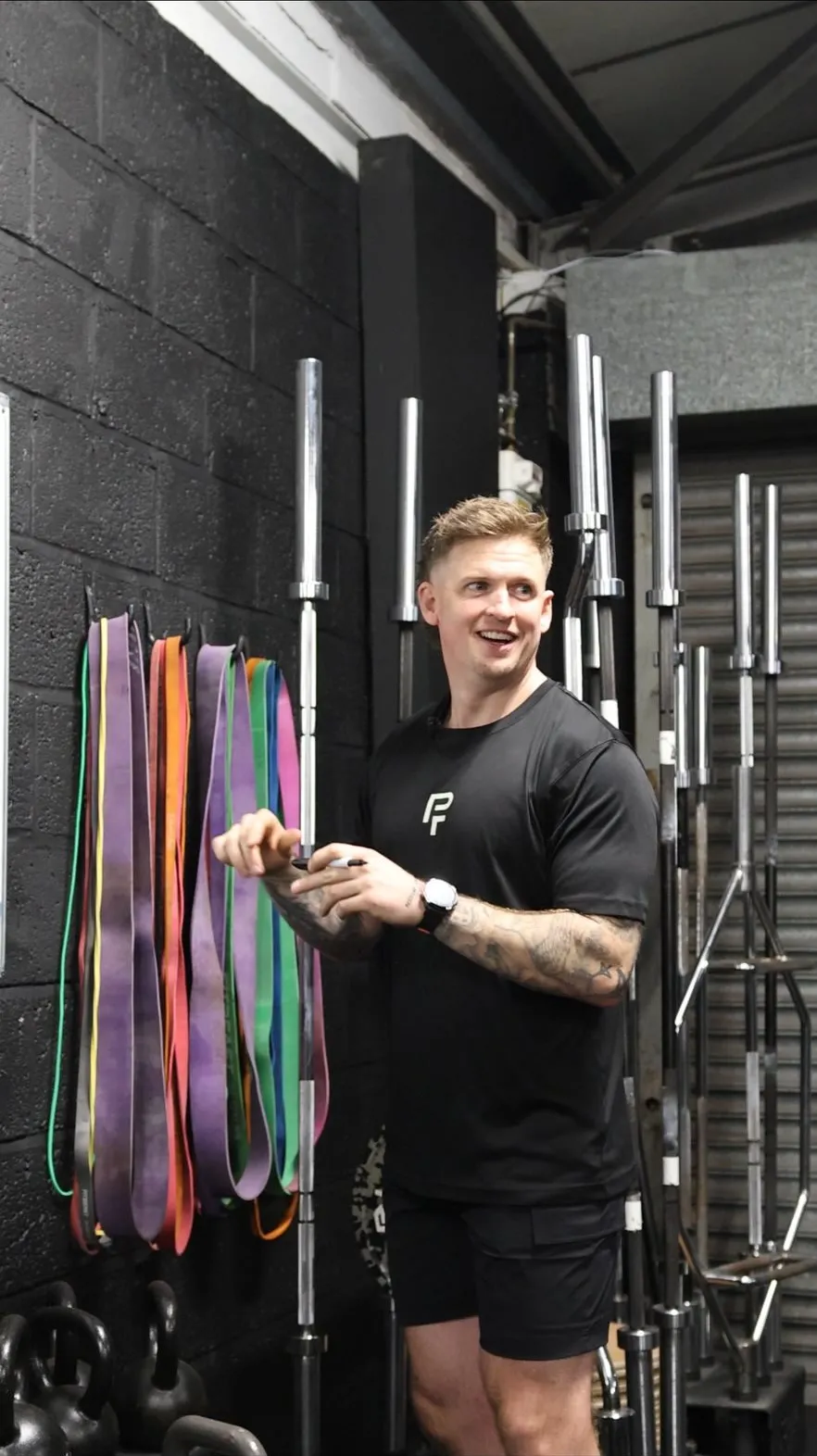
The most common starting point for women in our gym is “I’ve never properly lifted anything heavy and I don’t know where to start.” That’s fine: it’s what we’re built for.
Here’s how we usually approach it.
A coached start. Every new member begins with a free fifteen minute discovery call, then meets their coach on the floor before the first session of the 6 Week Experience. We talk about goals, identify any history of injury and match you to a programme at the right level.
First four to six weeks. Light loads, focus on movement quality. You’re learning the patterns. The reps look slower than the rest of the room; that’s by design. We do not load on top of broken movement.
Weeks six to twelve. Load starts going up. Confidence climbs faster than expected. You’ll lift things you didn’t think you could lift within this window. The biggest shift is psychological: you become someone who lifts.
Months three to twelve. Outputs compound. The deadlift you couldn’t do at 40kg at week one is at 60 to 80kg by month six. The squat moves similarly. Body composition shifts. The wardrobe changes.
If this is where you are (never properly lifted, not sure what to do), the easiest first step is a free fifteen minute discovery call. The getting started page explains how it works.
Common mistakes (and how we coach past them)
The patterns of well-intentioned strength training going wrong are predictable. Here are the four we see most often.
Going too light, indefinitely
You’ll feel productive lifting 5kg dumbbells, but adaptation requires that you actually challenge the muscle. Coached strength means progressing the load deliberately. The training has to be hard enough to drive change.
Programme hopping
Changing programmes every four weeks because of social media. Strength is a long game; the programme has to run long enough for the adaptation to compound. Eight to twelve weeks minimum before you change the structure.
Skipping the basics
Doing dozens of accessory exercises and avoiding the big lifts, usually because they feel intimidating. The big lifts are where the change comes from. Accessories support them; they don’t replace them.
Under-eating
You can’t build muscle in a deep calorie deficit. Coached strength training pairs with sensible nutrition, not aggressive dieting. Eat enough to recover; the body composition shift happens anyway.
How to start with us
If you’re ready to start strength training properly, the first step is a free fifteen minute discovery call with a coach. From there, everyone starts with the 6 Week Experience, a coached six-week block that gets you properly started.
If you want to read more first, our overview of how Physical Formula coaches covers the gym, the team and the philosophy. The comparison of small group PT and gym membership covers cost and value.
If you’d rather just talk, email info@physicalformula.com with a line about where you are with training currently and what you’re hoping to change. A coach will reply within 24 hours.