The feeling nobody admits to
Here is a secret from all our years around gym floors: almost everyone you see training confidently once sat in a car park, engine off, talking themselves into going in. Or didn’t, and drove home. The polished regulars, the early-morning lifters, the woman who seems to float through her session: most of them have a version of that story.
Gym anxiety, gymtimidation, whatever name it goes by this year, is one of the most common reasons people in Leamington Spa and everywhere else put off training: in a 2025 survey of UK adults who don’t belong to a gym, nearly half said they felt uncomfortable at the thought of joining one (Quinn, 2026). And it grows in silence, because nobody stands in reception announcing that they feel out of place. Everyone quietly assumes they are the only one.
You are not. And more importantly, the feeling is not evidence of anything true about you. It is evidence of how most gyms are built.
What the fear actually is
When people say they feel nervous about the gym, it is rarely the exercise itself they fear. Dig a little and it is almost always some blend of three things:
- Being watched. The sense that the moment you pick up a weight, the room will turn and assess you.
- Not knowing what to do. Standing in a forest of machines with no plan, trying to look purposeful while quietly panicking.
- Not belonging. The feeling that everyone else got a handbook you never received, and that this is a place for people who are already fit.
Every one of those is legitimate. And every one of them dissolves under the same three remedies, which we’ll get to. But first it helps to see why the standard gym environment manufactures these feelings in the first place.
It’s a design problem, not a you problem
A commercial gym is, structurally, a room full of equipment and strangers. Nobody is responsible for you. Nobody expects you on Tuesday. Nobody notices whether your squat is safe or your plan makes sense, because there is no plan unless you brought one. Plenty of members pay a flat monthly fee and then visit so rarely that paying per visit would have cost them less (DellaVigna and Malmendier, 2006), and the environment quietly reflects that.
Drop a beginner into that room and anxiety is not an overreaction. It is an accurate reading of the situation. You genuinely are unguided, unobserved and anonymous. The nervous feeling is your brain correctly noticing that nothing in this room is designed to help you succeed.
Confidence was never going to come from the room. It comes from competence, familiarity, and being expected. All three can be built.
Once you see it that way, the question changes. It stops being “how do I become the kind of person who feels at home in a gym?” and becomes “how do I get competence, familiarity and expectation into my week as fast as possible?” That question has answers.
What actually builds confidence
Competence
Confidence follows skill, never the other way round. The day you know how to set up a squat, brace properly and trust your own positions, the mirror wall loses most of its power. You cannot talk yourself into this feeling. You have to be taught it, rep by rep, by someone who knows what good movement looks like.
Familiarity
The tenth visit feels nothing like the first. Same room, same you, completely different nervous system. Familiarity is simply exposure repeated until the strangeness wears off, which is why one of the most useful things a nervous starter can do is stack visits close together in the first few weeks: one study of new gym members (Kaushal and Rhodes, 2015) found that training consistently could turn exercise into a habit in around six weeks.
Being expected
This is the one almost nobody talks about. Walking into a room where someone says your name, knows why you’re there and has already planned your session is a very different experience from walking into a room of strangers. Expectation converts a public space into an appointment. Nervousness struggles to survive it.

Practical steps that work in any gym
If you are set on a commercial gym, these genuinely help. We would rather you start well anywhere than not start at all.
- Go at quiet times first. Mid-morning or mid-afternoon, the floor is calm and you can learn the room without an audience. Save peak hours for when the space feels like yours.
- Never walk in without a plan. A written session, even a simple one, removes the worst moment in gym anxiety: standing still wondering what to do next. Book the induction, ask for a programme, and follow it to the letter.
- Learn one pattern per week. Squat one week, hinge the next, press the week after. Depth beats breadth. Three movements done well will carry you further than fifteen done nervously.
- Anchor the habit to a fixed slot. Same days, same time. Decisions are where resolve leaks away; a standing appointment removes the decision.
- Remember what everyone else is doing. Which is thinking about their own session. The audience you feel watching you is much smaller than it seems, because people tend to overestimate how much others notice them (Gilovich et al., 2000), and the few who do notice a beginner may well be remembering their own first month with something close to affection.
All of that works. It is also, if we are honest, the slow road: you are building competence, familiarity and expectation alone, from scratch, with willpower as the only scaffolding. There is a faster way.
The shortcut: a room built so you can’t get it wrong
Everything that fuels gym anxiety is a gap: no plan, no feedback, no one expecting you. A coached small group fills every gap by design, which is why nervous starters settle in here faster than anywhere else we have seen.
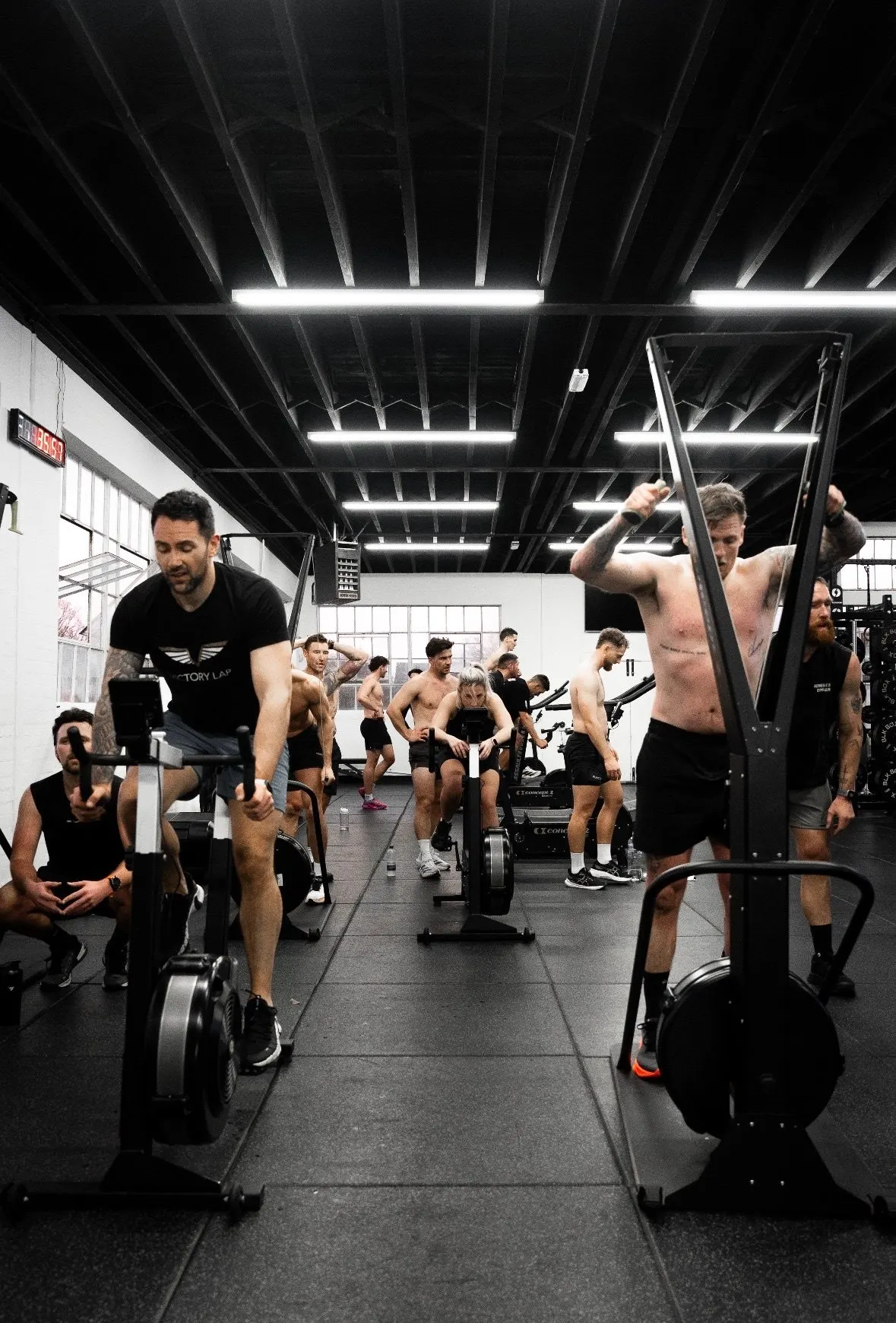
Your programme is written before you arrive, so there is never a moment of standing lost on the floor. A coach watches every set, so doing it wrong in front of everyone is structurally impossible; the coach’s entire job is to catch it before it happens, quietly and without fuss. And the room is capped at seven people who learn your name in the first week, so you are never anonymous and never on display. Just known, at exactly the level of visibility that feels safe.
Notice what this means for the fear itself. You do not need to defeat gym anxiety before you start. You simply choose a room where the things it feeds on do not exist. Most of our members did not conquer their nerves and then join us. They joined us, and the nerves ran out of things to be nervous about.
One of our members, Henry, put it better than we ever could. He joined at 56, well over 18 stone, after one short conversation talked him into a free try-out: “From the moment I walked in I was made to feel like one of the family. Everything immediately felt different.”
What walking in here actually looks like
Because the unknown is most of the fear, here is the entire sequence, demystified.
It starts with a short written enquiry that takes about two minutes. A coach, often me, replies within 24 hours and we arrange a free fifteen minute discovery call: a relaxed conversation about where you are, what has and hasn’t worked before, and what you actually want back. Tell us you’re nervous. You will not be the first that week.
If it feels right, you start the 6 Week Experience in a small group, on a programme scaled to where you are today, with a coach beside you from the very first session. Nothing is assumed, nothing is tested, nobody throws you into a workout to see if you survive. From there the whole machine (the programme, the coaching, the people who notice when you’re missing) starts working for you instead of against you.
Starting, nerves and all
Here is the truth we watch play out on our floor every month: the people who wait to feel ready never feel ready, because readiness is built inside the room, not outside it. The nervous version of you is the only version that can start, and it is enough.
Send us a short note. Tell us where you are, honestly, nerves included. A coach reads every enquiry and replies within 24 hours, and from there it’s a proper conversation about what you actually want. If you are still weighing up your options first, our guide to choosing a gym in Leamington Spa and our honest look at one-to-one PT versus small group training are good places to stand while you decide.